Home › Why Square Dancing?
Why square dancing matters more than ever — and why this club is different
Square dancing isn't just a fun night out. It's one of the most complete social, physical and cognitive activities available to people of any age. Here's the science — and the story.
🧠 Brain benefits
Square dancing is exceptional for your brain — at every age
Following calls, remembering sequences, adapting in real time, moving in sync with seven other people — square dancing demands genuine cognitive effort in a way that crosswords and puzzles simply don't. And research consistently shows that this combination of movement, music, memory and social coordination is uniquely powerful for brain health.
⚡
Split-second processing — hear a call, translate it, move. Builds decision speed at any age
🔄
New neural pathways form every time you learn a new call — neuroplasticity in action
Frontiers in Aging Neuroscience
76%
Reduction in dementia risk from regular dancing vs other leisure activities
NEJM, 2003 — 21-year study
#1
Dancing ranked highest of all activities studied for reducing dementia risk — above reading, crosswords, music
Albert Einstein College of Medicine
⚡
Rapid-fire decision making
When the caller gives a call, you have a fraction of a second to process and move. This rapid-response training strengthens executive function and processing speed — skills that matter in classrooms, workplaces and everyday life at any age.
🌱
Learning that never stops
A good caller deliberately varies the sequence every night. There's no routine to fall back on. You must listen, think and move continuously — which means your brain is always learning, never coasting. That's what makes it different from sequence dancing like line dancing.
🔄
Memory & long-term brain health
Remembering sequences exercises working memory — the same system that declines in dementia. A landmark 21-year study found social dancing reduces dementia risk more than any other physical or cognitive activity studied. The benefit compounds with regular attendance.
Source: NEJM Leisure Activities Study, 2003
"
My GP actually suggested it. She said it was one of the best things I could do for my brain. I thought she was pulling my leg. She wasn't. That was five years ago and I haven't missed a week.
— Square dancer, age 64, Brisbane
💪 Physical benefits
Two hours of movement — and you won't notice
One of the most powerful things about square dancing is that people move for two hours or more without noticing. It's low-impact, adaptable, and genuinely suitable for all fitness levels and ages. And unlike the gym, you'll actually want to come back.
🏃
Agility & quick direction changes
Square dancing involves constant changes of direction, pivots, stops and turns — building real agility and reactive movement that translates to sport, everyday life and injury prevention. For kids and teens especially, it builds athletic movement patterns.
🏋️
Core stability & small muscles
Maintaining formation, rotating, balancing through turns — square dancing engages the small stabilising muscles of the core, hips and feet that gym work often misses. These are the muscles that protect joints and prevent falls.
⚖️
Balance & coordination
Moving in formation, responding to calls, staying in rhythm — all of it builds proprioception and spatial awareness. For older dancers it's critical fall-prevention training. For younger dancers it builds coordination and body awareness that lasts a lifetime.
❤️
Cardiovascular fitness
A two-hour square dance session provides moderate aerobic exercise equivalent to a brisk extended walk — improving heart health, circulation and lung capacity. Without the dread of running.
🦵
Low-impact for all ages
Done in flat shoes on a smooth floor, square dancing is gentle on joints — making it accessible for people with arthritis, limited mobility, or recovering from injury. If you can walk, you can dance.
😄
Joyful movement that sticks
Because it's disguised as entertainment, you'll actually show up. Unlike the gym membership you stopped using in February, a dance you love is one you'll attend — week after week, year after year.
🤝 Social benefits
The loneliness epidemic — and why square dancing is part of the answer
Australia is in the middle of a loneliness crisis. Square dancing clubs are uniquely positioned to address this — not by accident, but by structural design. You cannot square dance alone.
1 in 4
Australians feel lonely often or always — rising since COVID-19
Australian Loneliness Report 2023
15 cigs
Social isolation is as harmful to health as smoking 15 cigarettes a day
Holt-Lunstad, Brigham Young University
29%
of Australians say they lack a sense of belonging in their community
Ending Loneliness Together 2023
🏘️
Multigenerational mixing
It's rare for 12-year-olds and 80-year-olds to share an activity as equals. Square dancing creates that naturally — the caller sets the pace for everyone, and skill level matters more than age. Older dancers mentor newer ones. Kids bring energy. Everyone contributes.
🌈
Multi-demographic belonging
Singles, couples, families, LGBTQ+ people, retirees, workers, locals, newcomers to Cairns — on the dance floor, none of those labels matter. What matters is listening to the caller and moving together. That shared focus creates connection across difference.
🏘️ Why modern square dancing is relevant now
This isn't your grandparents' square dance
Modern square dancing has evolved enormously from its folk roots. Today it's globally standardised, danced to any music in any era, and built around continuous learning. Here's why it matters in 2026.
🎵
Any music, any era
Modern callers dance to current pop, country, rock — anything in 4/4 time. You might dance to Taylor Swift, ABBA or classic country. The calls work with all of it.
🌍
A global community
Square dancing is danced in 50+ countries. Join Tropic Twirlers and you can dance with clubs across Australia, the US, Europe and Japan — travelling dancers are always welcome anywhere.
📚
Progressive skill system
The Callerlab program means there are recognised levels from Basic through to Challenge. You start where you start, and grow at your own pace — there's always more to learn, for life.
🧩
Teamwork by design
You cannot square dance alone. Every move requires 8 dancers working together. That cooperative structure builds genuine interdependence and trust between people who may have only just met.
✦ Why our club is different
All-position dancing — and what it really means
"Boy" and "girl" are positions in the square — not descriptions of people
Every dancer learns every position — so you can dance from anywhere, with anyone.
In square dancing, the caller says things like "Boys Trade" or "Girls U-Turn Back". Those words refer to your chosen position for this dance — not your gender.
Boy means the left-hand dancer in each couple. Girl means the right-hand dancer. Positional shorthand — standard language the whole square dance world uses.
💡 Heads up: you're more likely to hear "Blue" and "Green" than "Boy" and "Girl" at Tropic Twirlers. Both mean the same thing — your position, not your gender. Inclusive language is still an evolving conversation across the square dance world, so it pays to know both if you're planning on visiting other clubs.
In traditional square dancing, a woman usually dances the "girl" role and a man usually dances the "boy" role. In all-position dancing, everyone learns both roles. After a trade, a sashay, a zoom — you may find yourself in a different position. You just dance from wherever you are.
✦ All-position by design — dance with whoever you want
A square — 4 couples, 8 positions
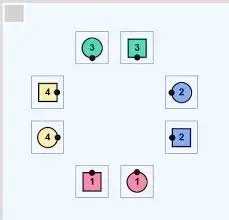
Blue
Green
(also called Boy/Girl at other clubs)
Traditional square dancing
Tropic Twirlers — all-position
→More calls use fixed gender roles; roles assigned by gender
→Mostly attended by established couples; singles may dance less without a regular partner
→You learn primarily one role — "boy" calls or "girl" calls
→End up in a different position mid-dance? It can get complicated
→LGBTQ+ dancers generally assigned a role based on gender
✓Position in the square determines role, not gender
✓Singles always welcome — no matched partner needed, ever
✓You learn the full dance — both roles, all positions
✓Wherever you end up mid-dance, you know what to do
✓LGBTQ+ dancers included by design — no role assignment needed
🕺
Better for every dancer
Learning both roles makes you a more complete, more versatile dancer. Experienced traditional dancers who dance all-positions often find it more challenging and more rewarding — because you're learning the full geometry of the square, not just your half. It's harder. It's also better.
🤝
Come as you are. Dance with whoever you want.
Eight people get up, stand in the square, and dance — in any position, with whoever they want. Roles are positional. Nobody has to be someone they're not. Nobody has to pre-assign anything. That's it.
Ready to experience all of this for yourself?
Sundays 2–4pm · Masonic Lodge Hall, Edmonton · hello@tropictwirlers.com.au
The loneliness epidemic — and why square dancing is part of the answer
Australia is in the middle of a loneliness crisis. Square dancing clubs are uniquely positioned to address this — not by accident, but by structural design. You cannot square dance alone.